

Ask any Palestinian about their favorite dish, and there’s a good chance they’ll say m’sakhan. The direct translation, “heated’, is a lazily applied moniker for one of the most delicious takes on chicken you will ever encounter. They could have easily named it “Knockout chicken”, “Swims in olive oil”, “Infinite onion chicken”, or some other combination that alludes to its magical ingredients.
This dish uses a lot of onions, olive oil, and an uncommon spice called sumac. Without these, it’s just roasted chicken in bread. Sumac is easy to find; Amazon carries it and so do most middle eastern markets. I have a silo that my aunt foraged for me so it’s hard for me to judge exact quantities, but you will need a lot.
1. Gather your ingredients
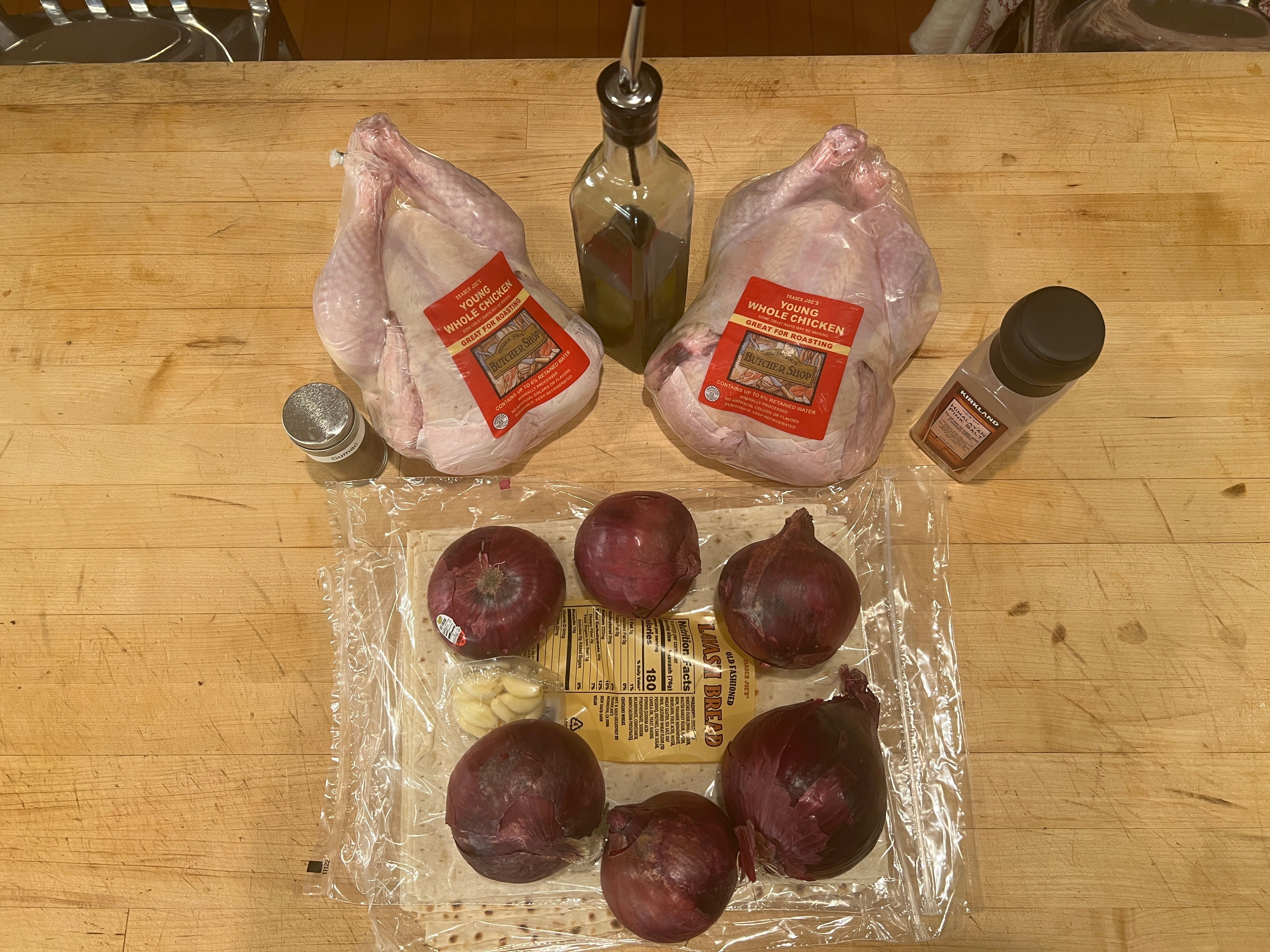
Two whole chickens (feeds 6-8, make one if you want less, and reduce the onions to 4)
7 large red onions (yes, lots of onions, I added the seventh whilst chopping)
2 cups olive oil
Lots of sumac (minimum 4 ounces)
Thin bread (lavash, saj, or any similar large sheet thin crust bread, not pita)
Salt, cumin, paprika
2. Disassemble the chicken
If you would rather not manhandle your birds go for skin-on breasts, thighs, and drumsticks and skip this step.
Lay the chicken breast-down and cut through the backbone using good shears. Flip the birds (literally), push down with your palms to break the breastbone, then cut through the middle of the breast to make two halves. You might need to pull out the wishbone if your shears aren’t strong enough.


Use a sharp boning or paring knife to slice around the thigh until you see the joint. Pop the thigh perpendicular to the breast to reveal the joint and then cut through the tendons. The key to taking birds apart is to never cut through thick bones. Always find a joint, pop it, and slice through the tendons.
Flip the breasts skin side down and remove the ribs and breastbone, then cut the breasts in half.
I leave the wings attached, it’s not worth the hassle. They pull off easily when everything is cooked.
2. Season the chicken


Apply sumac liberally on both sides of the chickens, and when I say liberally, I mean liberally. Add some salt, sprinkle cumin and paprika, and place uncovered in a container in the fridge for a few hours, or ideally overnight.
Note: This helps dry out the skin and allows the the spices to diffuse through the chicken. You can skip the refrigeration part if you’re short on time, but it won’t taste as great.
3. Chop the onions
This dish requires a lot of onions. If you think you have enough onions, add one more.
Growing up, If we ever ran out of onions while there was still chicken, there would be pandemonium, and we would fight each other for the last bites.
You can use a food processor, but it’s preferable to go the Palestinian way and suffer through the process with a knife. Quarter the onions, peel the skin, then chop them roughly to maintain their structure.


Place the onions in a container, pour over the olive oil, and do the same thing with the sumac; apply liberally, then add some salt.
Cover with plastic and leave in the fridge for a few hours or overnight.
Note: This dish can take a lot of olive oil. I don’t measure as long as I know I put enough to coat the onions and drip down to the bottom of the pot. Once cup would be my minimum, two doesn’t hurt. You can reuse the excess; it will just taste like chicken!
3. Brown the chickens and start the onions.
I always brown my proteins for stews or roasts. It takes a little bit of effort but guarantees browned flavorful meats that are less likely to dry out (the alternative is to skip browning and cook uncovered for the last 20 minutes). This is also better for my method of jamming everything into one Dutch oven.
Heat the Dutch oven on medium high, use a second pan to speed up the process. Coat lightly with olive oil, and start skin down. Roughly five minutes per side should get you a nice golden brown. Transfer the chickens to a side dish.


Pre-heat your oven to 350°F.
Drop the onions into the Dutch oven. Make sure you scrape all the olive oil out, and stir for a few minutes.
After 5 minutes everything should be hot. Start piling on the pieces of chicken. It’s ok if some of them get doused in the oil and onions, these will be the best pieces.


Apply another sprinkling of sumac for good measure.
Cover the pot and place it in the oven (be careful, it will be heavy).
Let cook undisturbed for 75 minutes. Remove the pot from the oven and check for doneness. A fork should go through easily and the chicken should be close to falling apart (a meat thermometer should read 175+°F). If not, roast for another 15 minutes and check again.


Note: You can use a roasting pan if you don’t have a Dutch oven. Coat the pan with olive oil, lay the onions down, then place the chicken on top and cover tightly with aluminum foil. Roast for 75 minutes at 350°F, then check for doneness.
The traditional method separates the onions and chicken at this stage by cooking the onions separately on stove top for roughly 30 minutes (until they are soft and cooked through). This gives you cleaner olive oil flavored onions. I prefer my method because the onions cook in dripping chicken fat and can still be strained and recoated with the oil at assembly.
4. Assemble and roast
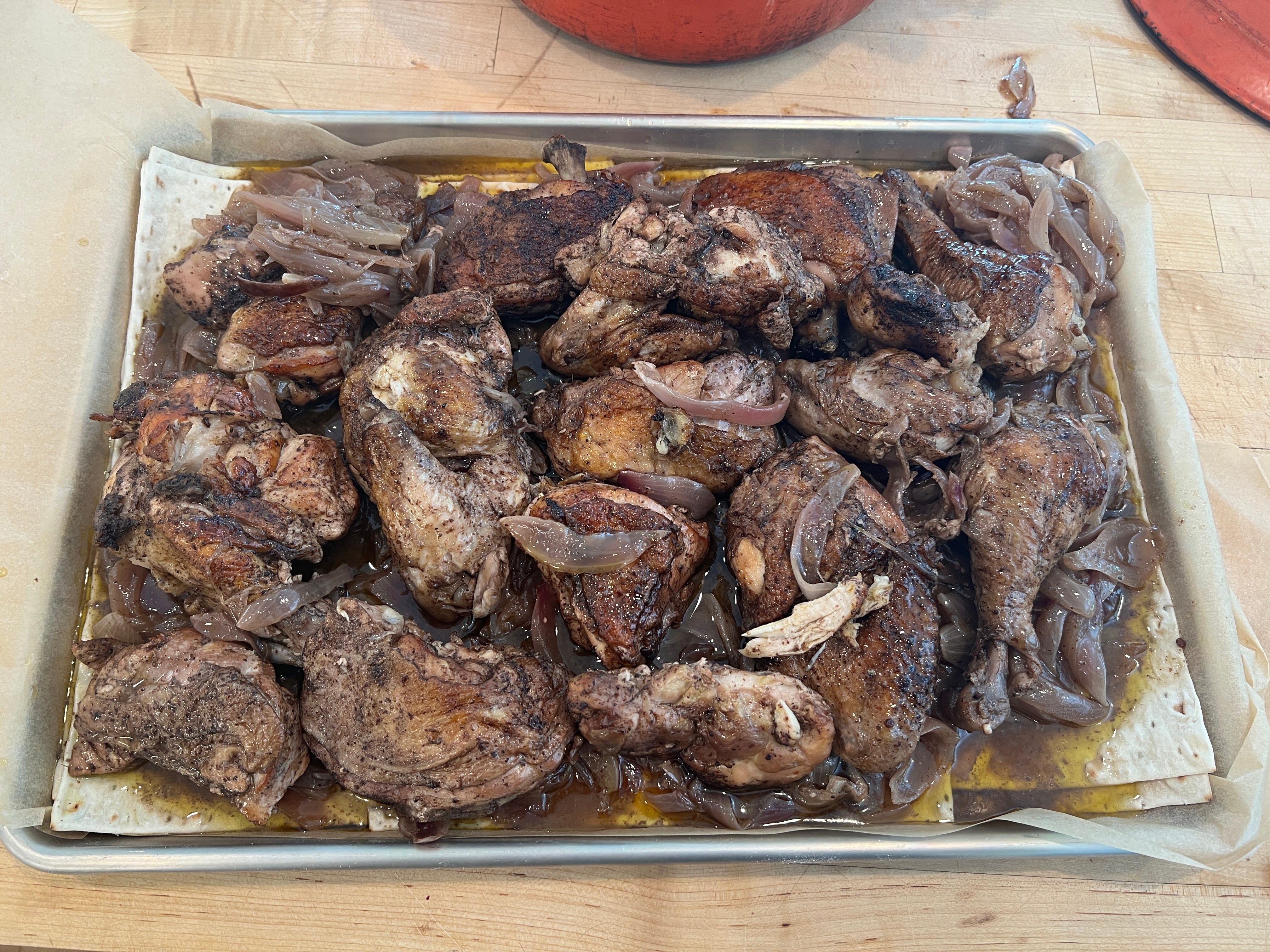
Transfer the chicken to a side plate. Increase the oven temperature to 400°F.
Line a large rectangular sheet pan with the flat bread (I lined with parchment paper to make it easier to move but that’s optional). Multi-layer the bread if it looks thin.
Use a slotted spoon to transfer the onions onto the bread, then spoon olive oil from the pot all over. Place the chicken on top, add more olive oil, then roast in the oven for 15 minutes to crisp up the bottom of the bread. Watch this step closely, it could be done in 10 minutes.
5. Eat!
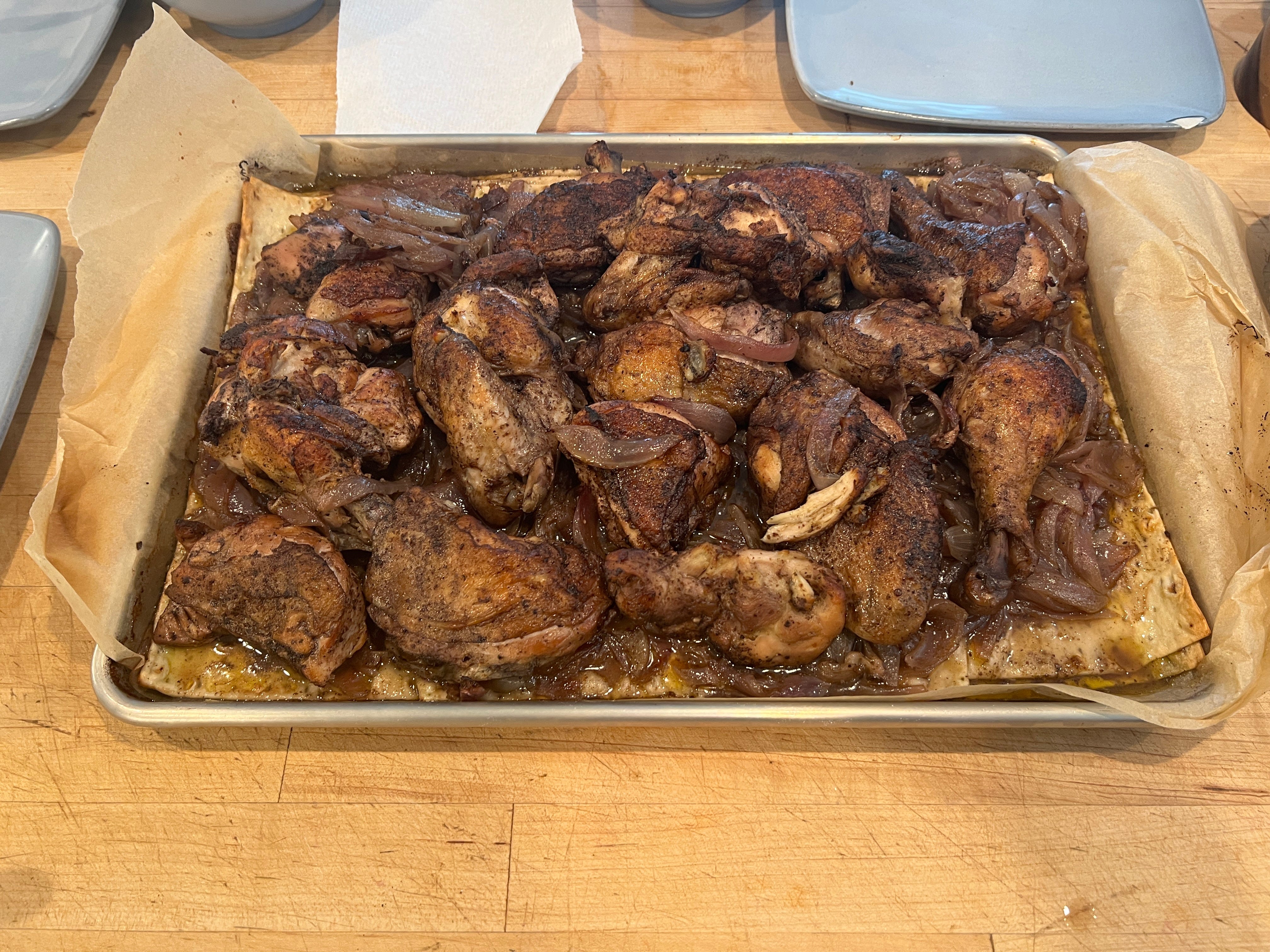
Serve the chicken on plates with pieces of the cooked bread and onions or eat animal style from the communal tray.
Chop up some cucumbers in Greek yogurt and serve on the side for a palette cleanser.
Don’t fight over the onions!
Make it enough times and the chicken becomes you
I keep coming back to this recipe. It's so good and it's a big hit with guests too!